.svg)
Note:
-
This feature uses AI. To enable it, your organization must first sign an addendum to your Mend.io contract. Please contact your CSM to initiate this process.
-
This feature is in closed beta.
-
Currently, the Project Risk Factors collection is triggered only by SAST scans. Future updates will extend this to all scan types.
Overview
This feature delivers AI-driven project classification that analyzes code context (imports, functions, classes) to identify sensitive domains (PII, payments, healthcare, etc.) and apply labels for filtering and workflows.
With this feature, Security Managers can accurately prioritize security issues by factoring in various project traits, not just vulnerability severity, streamlining prioritization at scale.
Getting it done
-
Navigate to your profile --> Administration.
-
Toggle AI-Based Project Classification on.
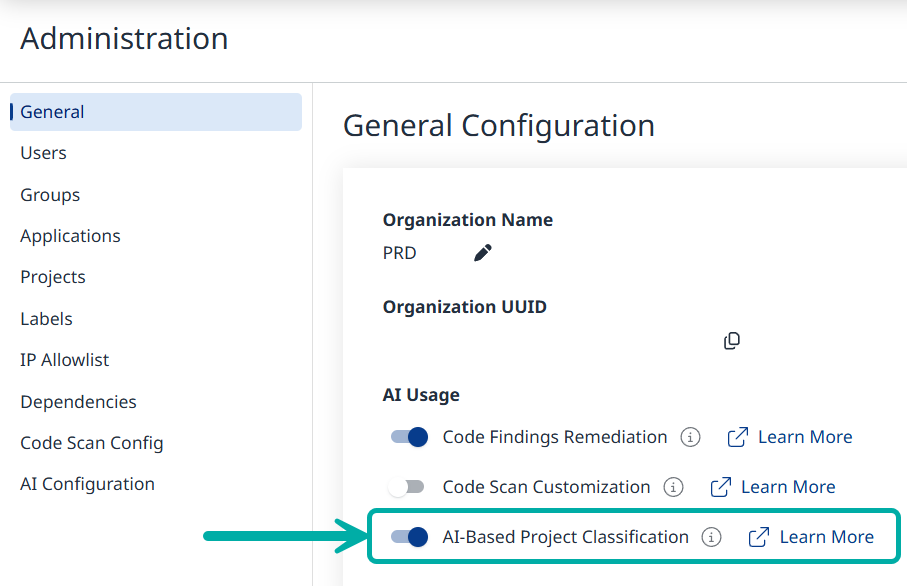
Note: Once enabled, the feature will apply to both CLI and Repository Integration scans.
When enabled, snippets of your source code and project details will be shared with Mend.io’s AI model to help extract contextual information and risk factors. This will result in relevant projects having context-based classification labels and risk factors assigned to them automatically.
Context-Based Labels
The context-based labels can be used to cover two main use-cases:
-
Filtering/sorting projects in the Mend AppSec Platform’s Applications/Projects view.
Example: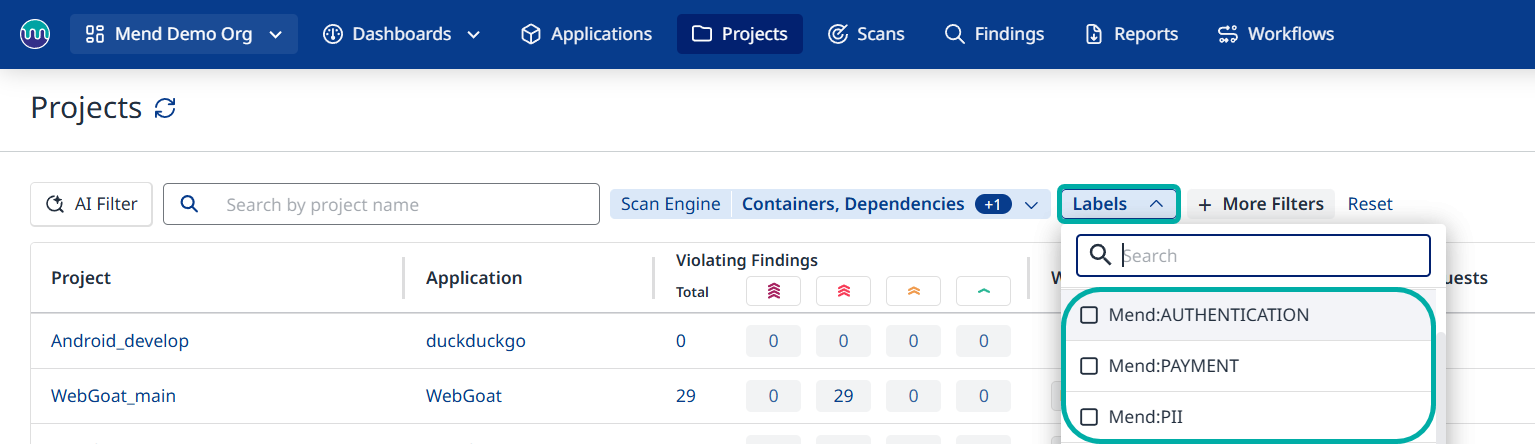
-
Creating Automation Workflows that are triggered based on the labels.
Example:
List of Labels
-
Mend:<PROJECT-CLASSIFICATION>
-
AUTHENTICATION
-
PAYMENT
-
PII
-
etc.
-
-
Mend:ADMIN
-
Mend:TEST_PROJECT
-
Mend:INTENTIONALLY_VULNERABLE
-
Mend:LOCAL_APP
Context-Based Risk Factors
The contextual classification of risk is manifested in the platform as risk factors, visible in the Project Risk Factors column of your Applications and Projects views.
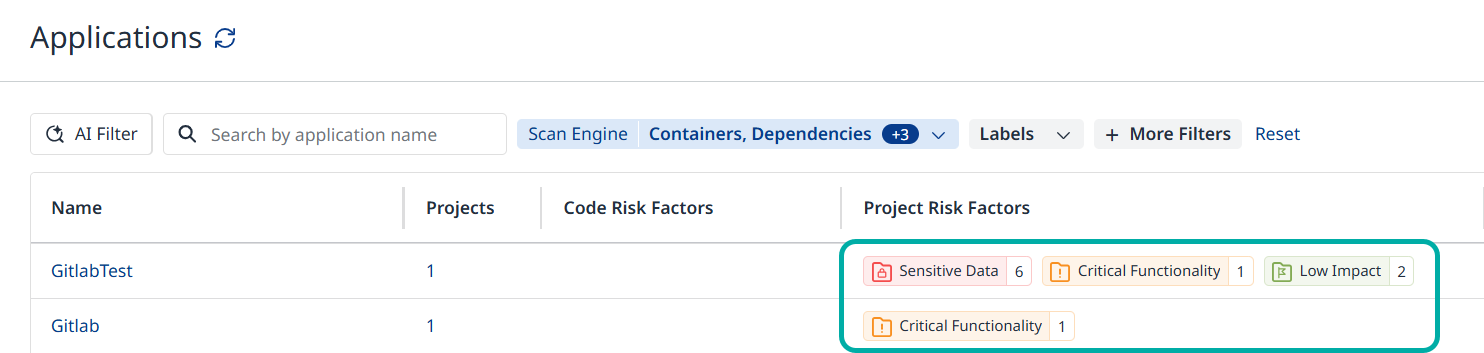
Hover over a risk factor chip to reveal additional information.
Contextual Risk Categories
The context-based risk factors are grouped into the following main and sub-categories:
-
Sensitive Data
-
PII(personally identifiable information, e.g., names, emails, SSN, phone, address) -
Payment(e.g., credit cards, transactions, billing) -
Healthcare(e.g., patient records, diagnoses, medical info) -
Biometric(e.g., fingerprints, face recognition, voice) -
Location(e.g., GPS, coordinates, addresses) -
Government(e.g., tax records, citizen data, compliance)
-
-
Critical Functionality
-
Admin(e.g., system config, user management)
-
-
Low Impact
-
Intentionally Vulnerable(most prominently in benchmark projects) -
Local App(e.g., local Python script, desktop app that does not require web access)
-
The Risk Factor Evidence Page
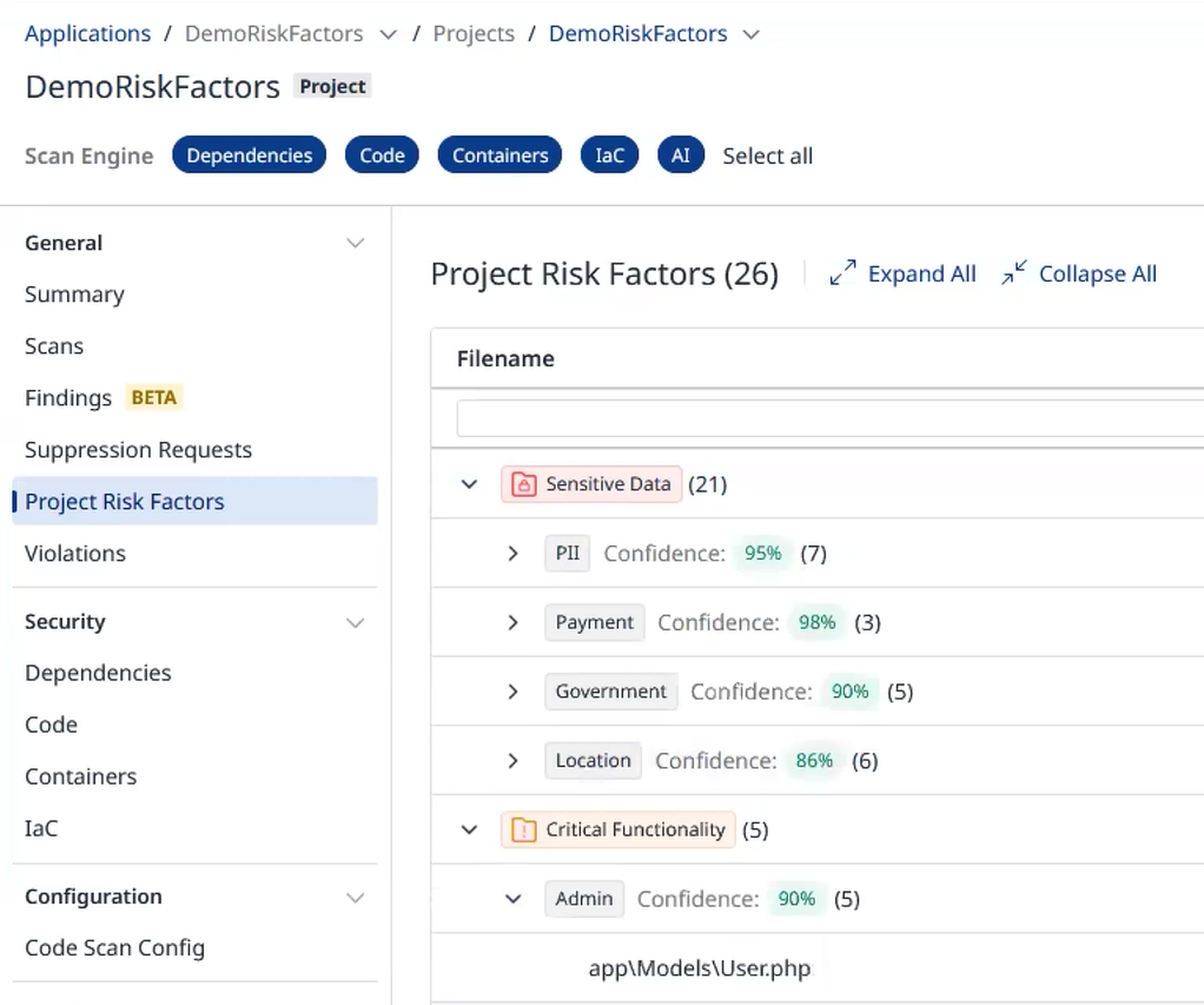
Navigate to Administration → Project Risk Factors to see a dedicated page where you can explore the reasoning behind each classification, including the code signals (function names, classes, imports) that contributed to it.
You can also reach this page by clicking through a contextual risk category. For example: Click the Payment category to reach the evidence page and see which code patterns (e.g., credit card processing functions, billing imports) triggered the classification.
If you determine a certain classification is incorrect, you have the option to dismiss it from the evidence page.